Lyme Disease, Co-Infections & Biomagnetism Therapy: Supporting Recovery from Persistent Symptoms

Case Notes from My Clinic #1: Looking Beyond Recurrent Cold Sores
July 15, 2026
Biomagnetic Pair Therapy for Chronic Conditions: What to Consider Before You Book
September 4, 2026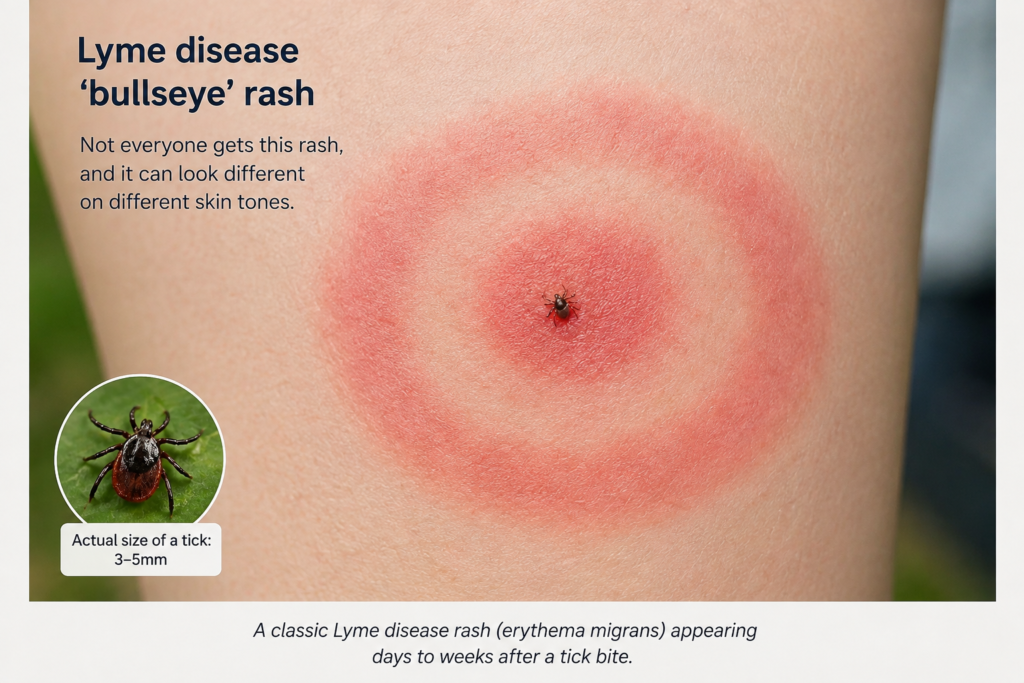
Lyme disease can be difficult to recognise because it doesn’t always look like one illness.
Over the last few years, I’ve worked with a number of clients with diagnosed Lyme disease or complex symptoms associated with Lyme and other infections.
What strikes me is how often the story is similar.
Fatigue. Brain fog. Migrating joint and muscle pain. Poor sleep. Headaches. Tingling or numbness. Digestive problems. Palpitations. Anxiety. A feeling that your body simply isn’t functioning as it used to.
Individually, these symptoms can have many possible causes. Together, particularly with a history of tick exposure, they can warrant a closer look.
What is Lyme disease?
Lyme disease is a bacterial infection transmitted through the bite of an infected tick. In the UK and Europe, it is caused by bacteria belonging to the Borrelia burgdorferi sensu lato group.
The well-known “bullseye” rash—erythema migrans—is an important sign of Lyme disease, but not everyone notices or develops one.
Many people don’t remember being bitten either.
Ticks can be tiny, and exposure can happen while walking the dog, gardening, horse riding, camping or simply spending time in woodland or long grass.
This means that by the time a collection of seemingly unrelated symptoms develops, the possibility of Lyme disease may not even cross someone’s mind.
Lyme disease symptoms: when the pieces don’t seem to fit
Lyme can affect different systems within the body, so symptoms can vary considerably.
They can include:
- Persistent or migrating joint and muscle pain
- Severe or unexplained fatigue
- Brain fog, poor concentration and memory problems
- Headaches and dizziness
- Nerve pain, tingling or numbness
- Sleep disturbance
- Palpitations and some other cardiac symptoms
- Changes in mood
- Reduced exercise tolerance
This is one reason people can spend months investigating symptoms individually without realising there may be a connection.
And for women in their 40s and 50s, symptoms such as brain fog, poor sleep, anxiety, palpitations, fatigue and aching joints can understandably be attributed to perimenopause or menopause.
Lyme co-infections: it’s not always just Borrelia
Ticks can carry more than one microorganism.
Depending on where exposure occurs, other recognised tick-borne infections include Babesia and Anaplasma.
Babesia is a parasite that infects red blood cells and can cause symptoms including profound fatigue, fever, headaches, muscle aches and sweats.
Anaplasma phagocytophilum can cause fever, headache, muscle aches and significant malaise.
Bartonella is also frequently discussed within the Lyme community. Bartonella species certainly cause human illness, although the extent to which Bartonella is commonly transmitted alongside Lyme through ticks remains debated within conventional medicine.
This complexity matters because two people carrying a Lyme diagnosis may have very different symptom pictures.
Why can symptoms continue after Lyme treatment?
Antibiotics are the established medical treatment for Lyme disease and can be highly effective, particularly when the infection is identified early.
However, some people continue experiencing fatigue, pain, cognitive difficulties and other symptoms after appropriate treatment.
This is commonly referred to as Post-Treatment Lyme Disease Syndrome (PTLDS).
Medicine doesn’t yet have all the answers about why some symptoms persist.
This is often the point at which people begin looking for additional, complementary ways to support their recovery.
How could Biomagnetism Therapy support Lyme recovery?
Biomagnetism Therapy is a gentle, non-invasive complementary therapy using pairs of medium-strength magnets placed at specific points on the body.
The Biomagnetism model works on the principle that areas of physiological imbalance can develop altered local conditions within the body.
Using specific magnetic pairs, the aim is to encourage these areas towards a more balanced state.
Creating an environment that supports recovery
Within Biomagnetism, we consider the internal environment as well as the pathogen.
The theory is that by helping to neutralise areas of altered pH, we may help create conditions that are less favourable to imbalances associated with microorganisms such as Borrelia, while supporting the body’s own regulatory processes.
It’s important to distinguish this theory from established medical evidence: clinical research has not demonstrated that Biomagnetism eradicates Borrelia or other Lyme-associated pathogens, and I don’t use it as a substitute for appropriate medical treatment.
For me, the objective is broader.
I’m trying to create the best possible conditions for the body to recover.
Supporting the body’s detoxification pathways
When someone has been struggling with complex symptoms for months or years, I don’t focus exclusively on Borrelia.
I look at the person as a whole.
That includes supporting the body’s natural elimination and detoxification systems—including the liver, kidneys, lymphatic system and digestive system.
Within the Biomagnetism approach, specific magnetic pairs are used with the intention of supporting these regulatory pathways and helping the body become more effective at processing and eliminating what it no longer needs.
I often explain it to clients like this:
It’s not only about what your body is dealing with. It’s also about how effectively your body is able to process and clear what it no longer needs.
As the overall burden on the body reduces, the aim is to better support normal immune function, regulation and resilience.
And that is often when clients begin reporting changes.
More energy.
Clearer thinking.
Better sleep.
Less pain.
Fewer crashes after activity.
Greater physical and mental stamina.
Why I recommend a series of Biomagnetism treatments
Complex health problems rarely develop overnight, and I don’t expect them to disappear after one Biomagnetism session.
I think of the process as peeling back layers.
During each treatment I assess the body and work with the imbalances presenting at that particular time.
As the body responds, the picture can change.
At the next appointment, different priorities may emerge. We assess again and continue working with what the body presents.
That’s why, for long-standing and complex Lyme-related symptoms, I generally recommend a series of Biomagnetism Therapy treatments rather than a single session.
The aim isn’t simply to chase individual symptoms.
It’s to support the internal conditions in which the body can function more effectively.
What I’ve observed in my Lyme clients
This is where Biomagnetism and Lyme disease have become particularly interesting to me.
To date, every Lyme client I’ve worked with has reported some degree of improvement.
Those improvements have ranged from subtle changes in energy and cognition to much more significant reductions in overall symptom burden.
Importantly, the pattern is usually gradual rather than dramatic.
A little more energy.
Less pain.
Clearer thinking.
Deeper sleep.
Being able to walk further without crashing afterwards.
Then, over a series of sessions, those small improvements can begin to add up.
I’m particularly interested in function rather than simply ticking symptoms off a list.
Can you do more than you could before?
Are your bad days becoming less frequent?
Do you recover more quickly after activity?
Are you sleeping and thinking more clearly?
Do you feel more like yourself again?
For somebody who has been unwell for a long time, those can be extremely meaningful changes.
These are my practitioner observations rather than evidence that Biomagnetism cures Lyme disease. Biomagnetism remains a complementary therapy, and good-quality clinical research has not established it as a treatment that eradicates Lyme infection.
Could your unexplained symptoms be connected?
Having fatigue, brain fog or joint pain does not mean you have Lyme disease.
But if you’ve been struggling with a seemingly unrelated collection of symptoms, it can be useful to look at the bigger picture.
Ask yourself:
Have I spent significant time walking, gardening, riding or working outdoors?
Have I lived in or visited areas where ticks are common?
Do I remember an unexplained rash or illness following possible tick exposure?
Did several apparently unrelated symptoms begin around the same period?
If the answer is yes, speak to your GP or an appropriately qualified medical professional about whether Lyme disease should be considered.
Biomagnetism should never replace appropriate medical investigation or antibiotic treatment for Lyme disease.
Biomagnetism Therapy for Lyme symptoms in West Sussex
I offer Biomagnetism Therapy in East Wittering, near Chichester, West Sussex, and work with people experiencing a wide range of complex and persistent health issues.
If you’ve already received medical care for Lyme disease but are still struggling with fatigue, brain fog, pain, poor sleep, reduced stamina or other persistent Lyme symptoms, Biomagnetism Therapy may be something you’d like to explore as part of your wider recovery.
For complex cases, I generally recommend approaching treatment as a course rather than expecting everything to change after one appointment.
Ready to explore Biomagnetism Therapy?
If you’re wondering whether Biomagnetism could support you, you don’t have to work that out by yourself.
Book a Biomagnetism Therapy session with me and we can get started.
Not sure whether it’s right for you?
Book a Discovery Call and tell me what’s been going on. We can discuss your symptoms, your health history and whether Biomagnetism Therapy could be an appropriate next step.
Bibi McGee Wellness | Biomagnetism Therapy | East Wittering, Chichester, West Sussex
Biomagnetism Therapy is a complementary therapy and is not a substitute for medical diagnosis or treatment. Lyme disease requires appropriate medical assessment and, when diagnosed, treatment in accordance with medical guidance. Statements about pH, pathogens, detoxification and immune support describe principles and aims used within Biomagnetism practice and should not be interpreted as clinically established mechanisms or claims that Biomagnetism eradicates infection.